I still remember the first time I stood at the edge of a cliff in Tsushima, the wind lashing Jin's cape as the music swelled. Down below, a Mongol patrol ambled through a field of red spider lilies. I wanted to leap, to fly, to descend upon them like a true ghost. Instead, I carefully navigated a series of ledges, or simply dropped into a roll, breaking immersion. Was it just me, or did anyone else yearn for more freedom in that moment?
Fast forward to 2026, and I’m still replaying Ghost of Tsushima\u2014soaking in its beauty, perfecting its combat\u2014while simultaneously devouring every scrap of footage I can find about Rise of the Ronin. Team Ninja’s action-adventure title had teased a grappling hook before, but it was the reveal of a handglider that made me rethink everything I wanted from an open-world samurai game. Could Sucker Punch take a page out of that book? Absolutely. If Ghost of Tsushima 2 \u200b\u200bwants to break free from the Ubisoft-style open-world fatigue, it needs to embrace the wind and give Jin\u2014or a new protagonist\u2014the ability to soar.
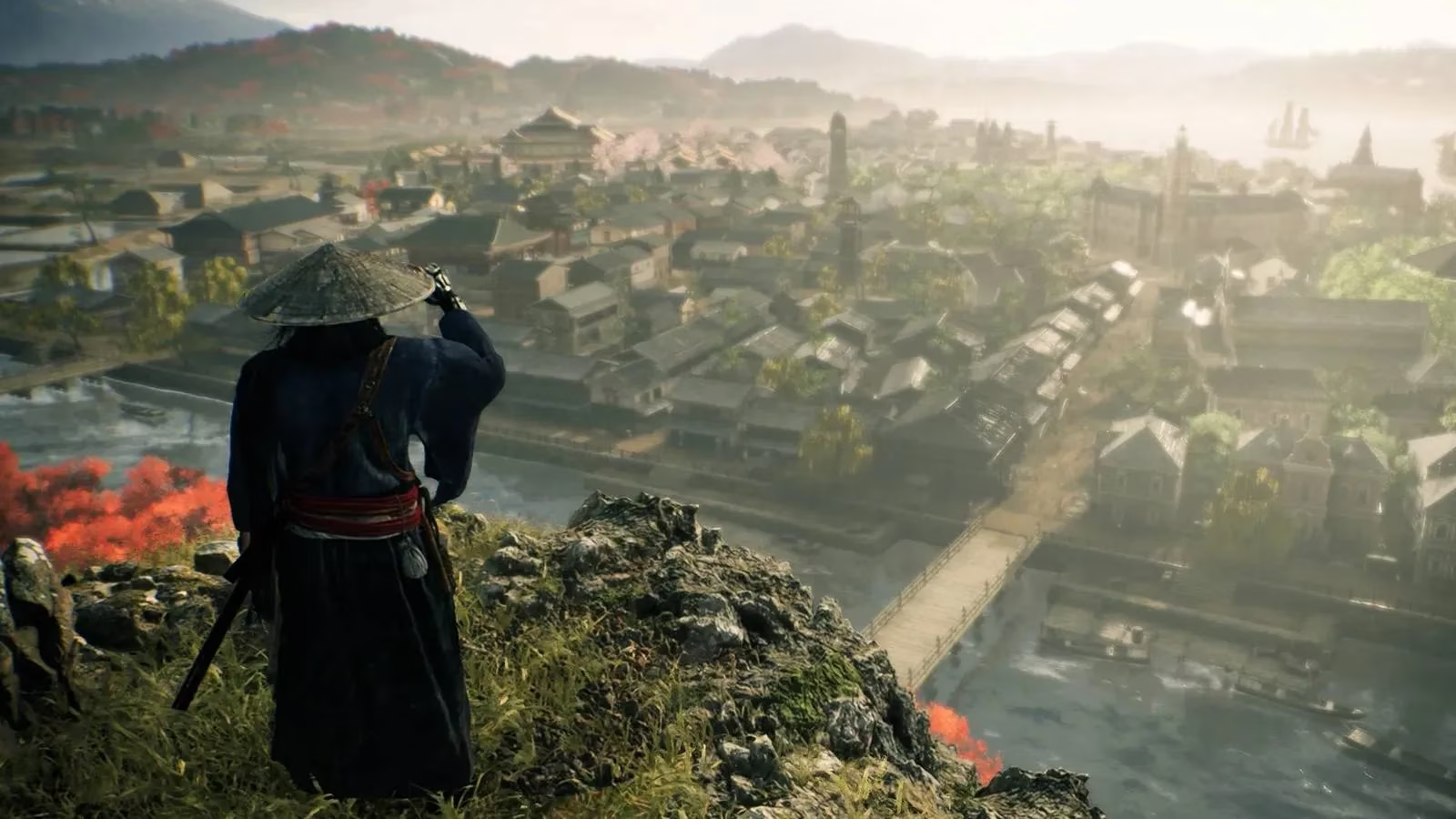
I can already hear the purists grumbling. \u201cBut a glider? In a grounded historical epic?\u201d Let me ask you this: did you bat an eye when Jin pinpoint-parried three spearmen at once, or when he used the grappling hook to swing across chasms like a 13th-century Batman? Suspension of disbelief is a funny thing. A handglider\u2014perhaps constructed from bamboo and silk, painted with the Sakai clan\u2019s emblem\u2014wouldn\u2019t just be a neat gadget; it would be a logical extension of the game\u2019s existing mobility. The first game gave us a grapple. Why not let us combine it with a glider to chain movements and cover more ground without ever touching the earth?
My frustration with horseback travel in Ghost of Tsushima was never about its artistry. Riding through the lush forests and golden groves feels meditative, almost sacred. But after dozens of hours, the novelty wears off. I found myself fast-traveling more and more, skipping the very scenery Sucker Punch worked so hard to craft. That\u2019s a shame. Now imagine a sequel where you crest a hill, deploy a glider, and ride the thermal currents toward a Mongol fort. As you sail over watchtowers, you spot a hostage cage, a commander, and a brazier ready to be shot with a flaming arrow. Engagement with the world becomes vertical, not just horizontal. Exploration turns into a dance of wind and gravity. Wouldn\u2019t that keep you from mashing the \u201cskip to destination\u201d button?
Rise of the Ronin\u2019s traversal mechanics struck me as pure kinetic joy. The ability to use a grappling hook to scale a roof, then leap off and immediately unfurl a glider, losing no momentum, is exactly the kind of flow-state gameplay that modern open worlds desperately need. I can see Sucker Punch adapting this so seamlessly that it feels uniquely \u201cTsushima.\u201d Imagine the guiding wind\u2014already a brilliant navigational tool\u2014growing stronger when you\u2019re airborne, literally pushing your glider toward points of interest. Or picture this: you\u2019re tracked by a pursuing samurai on horseback, so you launch yourself off a bridge, grapple a tree branch to redirect, and glide under the cover of bamboo until you vanish. That\u2019s the ninja power fantasy the first game only hinted at.
And combat? Don\u2019t even get me started. I\u2019ve rewatched the State of Play countless times, envisioning how \u201cdeath from above\u201d could work with a glider. In Ghost of Tsushima 2, you could silently deploy your glider from a temple roof, drift over an unsuspecting patrol, and land behind a general with your tanto already drawn. Or, in a chaotic battlefield, you could use it to disengage and reposition\u2014dropping a chalk bomb to obscure vision, then gliding away to a clifftop for a moment of respite. The possibilities for synergizing with stances, ghost weapons, and the environment are mouthwatering. It\u2019s not about making Jin some superhuman creature; it\u2019s about giving players more tools to express their own version of a cunning warrior.
I vividly remember the criticism lobbed at the original Ghost of Tsushima: that its open-loop design felt too safe, too familiar. Stands of bamboo, fox dens, haiku spots\u2014they were lovely, but they followed a formula we\u2019ve seen since Assassin\u2019s Creed II. A glider wouldn\u2019t automatically fix that, but what it would do is recontextualize how we interact with the map. When you can glide, you start to see the world differently. That distant mountain isn\u2019t just a backdrop; it\u2019s a launchpad. That rope bridge isn\u2019t just a crossing; it\u2019s a grapple point to gain height before a long drift toward a secret hot spring. The sheer verticality would make the map feel alive and reactive again.
Sucker Punch has never been a developer to rest on its laurels. They shattered expectations by transitioning from the cartoonish Infamous series to a brutally beautiful samurai tale. Now, in 2026, with Rise of the Ronin\u2019s clever movement fresh in memory, I have to believe the team is taking notes. They\u2019ll likely do it their own way\u2014maybe making the glider a crafting puzzle, where you harvest special silks from golden temple moths, or tying it to a new Legend of the Heavenly Wind. One thing is certain: if I\u2019m going to spend another hundred hours in feudal Japan, I want the sky to be my ally, not my limit. So let\u2019s cut the hesitation, Sucker Punch. Give us wings.