Five years ago, the winds of Tsushima first whispered through the gaming landscape, carrying with them a lesson often forgotten in an era of monumental technological leaps: that subtlety can be as revolutionary as spectacle. When Ghost of Tsushima emerged in the summer of 2020, it arrived not with the seismic shock of a paradigm shift, but with the gentle, persistent force of a changing tide. Critics were divided, some seeing its restrained ambition as a relic, others as a refreshing homage. Yet, as the years have unfurled like a silk scroll, its true nature has been revealed. In a genre that has since chased ever-expanding maps and dizzying systemic complexity, Sucker Punch's samurai epic stands as a testament to thoughtful, human-centric design—a lantern in the fog for a maturing open-world era.
A Living World, Not a Ledger
The game's most profound whisper was its rejection of the ubiquitous checklist. While other worlds plastered their horizons with garish icons and minimap clutter, Tsushima spoke in the language of the land itself. The player, as Jin Sakai, learned to listen. A thumb brushed across the controller's touchpad, and the world answered: a gust of wind, as purposeful as a master calligrapher's brushstroke, would rise to guide the way. It was a navigation system that felt less like consulting a GPS and more like learning to read the breath of the island—a dialogue between warrior and world.
This philosophy extended to its inhabitants. A golden fox would dart across a sun-dappled path, not as a quest marker with fur, but as a fleeting mystery. Following it was a choice, a moment of surrender to curiosity that often led to a hidden shrine or a moment of serene beauty. This idea—of using the environment as a gentle, enticing narrator—was so potent it echoed into future worlds. Years later, Final Fantasy VII Rebirth would employ baby chocobos in a strikingly similar dance of guidance, proving the elegance of the concept. In Tsushima, exploration was a conversation, not a chore list.
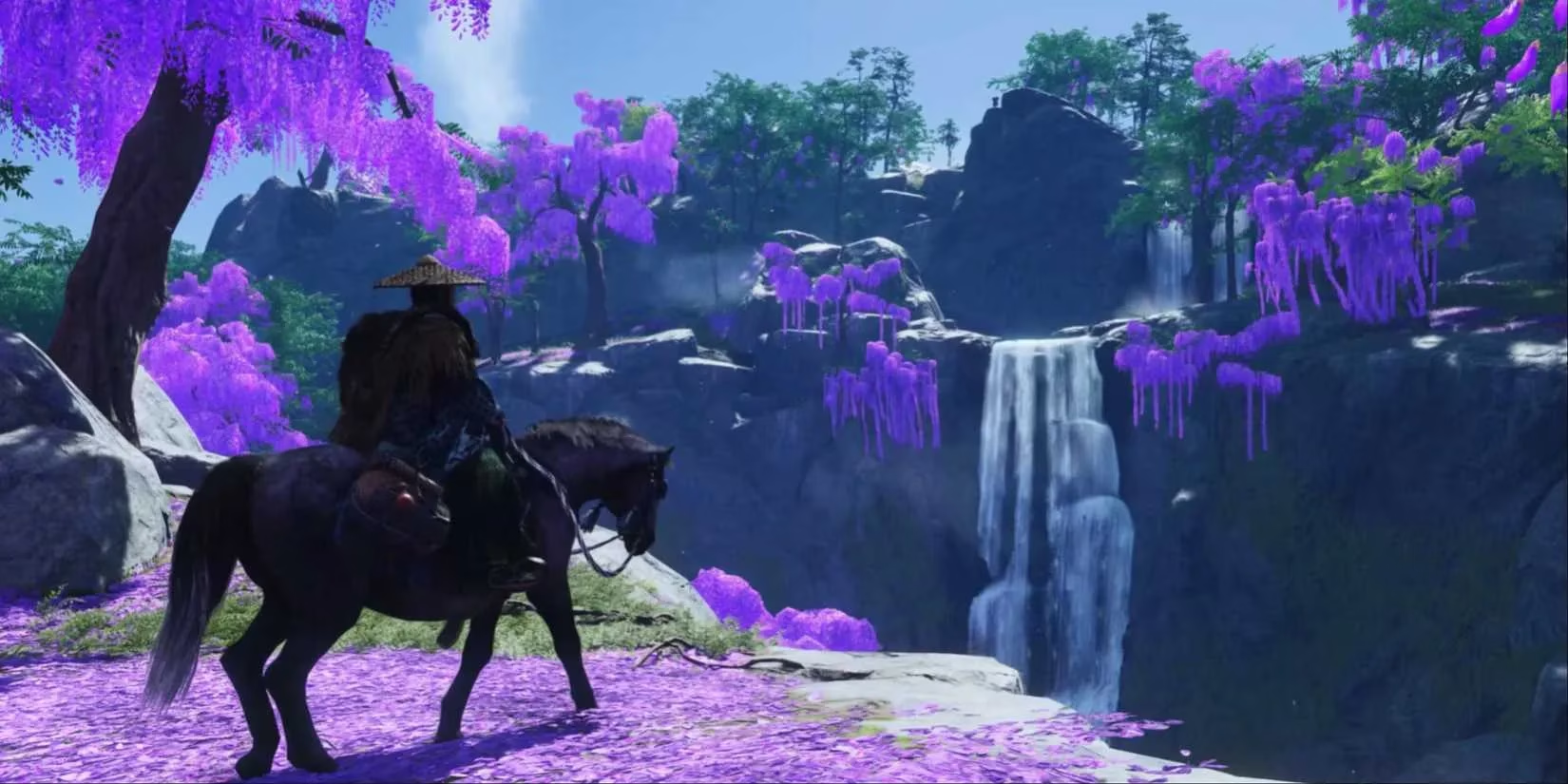
The Poetic Lens: A Photo Mode Unmatched
If the world was a poem, then the game provided the perfect quill to transcribe it. While photo modes have become a standard issue tool in 2025, none have yet captured the lyrical soul of Ghost of Tsushima's. It understood that a snapshot was not merely about freezing action, but about composing a mood, a haiku in visual form.
Its tools were those of a classical painter and a cinematic editor fused into one. Players could grade the light with the delicate care of a ukiyo-e master, washing scenes in the melancholic blues of twilight or the fierce reds of a battlefield sunset. But its genius lay in animation. With a few selections, a static frame could be imbued with life: a cascade of autumn leaves swirling like a shower of copper coins, or brooding thunderclouds gathering like a samurai's unresolved tension. Most remarkable was the ability to create tracking shots, setting keyframes to craft a miniature cinematic sequence as the camera swept around Jin standing in the rain. It transformed players from tourists into directors of their own Kurosawa-inspired dreams.
The Enduring Philosophy of Impact
Ghost of Tsushima was never a roaring revolution. It was, and remains, a quiet evolution. In the five years since its release, the open-world genre has seen titans rise—worlds of staggering scale and intricate, interlocking systems. Yet, amidst this grandeur, Tsushima's legacy endures in its focus on intimacy and atmosphere. It demonstrated that innovation isn't always about building a bigger box; sometimes, it's about polishing the one you have until it becomes a mirror, reflecting a more beautiful and believable experience.
Its influence is felt not in wholesale imitation, but in the thoughtful adoption of its principles:
| Ghost's Innovation | Philosophical Legacy | Modern Echo (2025) |
|---|---|---|
| Wind Navigation | Diegetic, immersive guidance | Increased use of environmental storytelling over UI clutter |
| Animal Guides | Rewarding organic curiosity & player agency | Side content triggered by world interaction, not map icons |
| Cinematic Photo Mode | Empowering player creativity as core gameplay | Photo modes now often include advanced storytelling tools |
In an industry where development cycles now stretch across half-decades and the pursuit of "more" can sometimes overshadow the pursuit of "meaning," Ghost of Tsushima stands as a beacon for a different path. It proved that a world could be compelling not just through the density of its activities, but through the consistency of its tone—a world that felt lived-in, not just built. Its combat, a dance between honor and pragmatism, was a metaphor for its own design: a precise, elegant system where every parry and strike mattered, much like its every design choice resonated with purpose.
As we look to the future, the lesson of Tsushima is clearer than ever. True longevity in game design often comes not from the loudest explosion, but from the most carefully arranged silence—from creating spaces where a gust of wind or the path of a fox can feel as significant as any epic boss battle. It showed that a game could be both a refuge of tranquility and a theater of conflict, a place where the player's journey was guided not by the hand of a developer, but by the heart of the world itself. In that, its quiet impact continues to resonate, a enduring whisper in the ever-noisy frontier of virtual worlds.