Let’s be honest – we’ve all told ourselves “just one more collectible” at 3 a.m. while our eyes burn and our real-life responsibilities whisper our names from the void. Narrative is great and all, but sometimes the simple, dopamine-drenched act of finding a shiny trinket and stuffing it into your virtual pockets is exactly what the soul needs. In an open world, collecting can feel like meaningless padding… until it’s not. When it’s done right, it turns into the breeziest, most satisfying low-stress task a gamer could ask for. You know the feeling: that little ding, the progress bar nudging towards 100%, the quiet superiority over your friends who “just do the main story.” Oh, yes. Let’s dive into some open-world masterpieces that transform hoarding into high art.

Let’s kick things off with a franchise that practically invented the modern collectathon while pretending to be a crime epic. The Grand Theft Auto series, especially GTA 5, understands something fundamental: humans are part magpie. We see glowing object; we must acquire glowing object. Hidden packages, alien spaceship parts, stunt jumps – the map is absolutely littered with distractions, each one a tiny invitation to ignore Trevor’s latest temper tantrum and instead climb a mountain to find a piece of scrap metal. And you know what? It’s glorious. Scouring every inch of Los Santos doesn’t just reward you with a sense of completion; it burns the map into your brain until you can navigate better than your own hometown. I’ve definitely learned more about highway networks from GTA than from any real-world atlas. Who needs a driving license when you can recite every alley in Vinewood from memory?
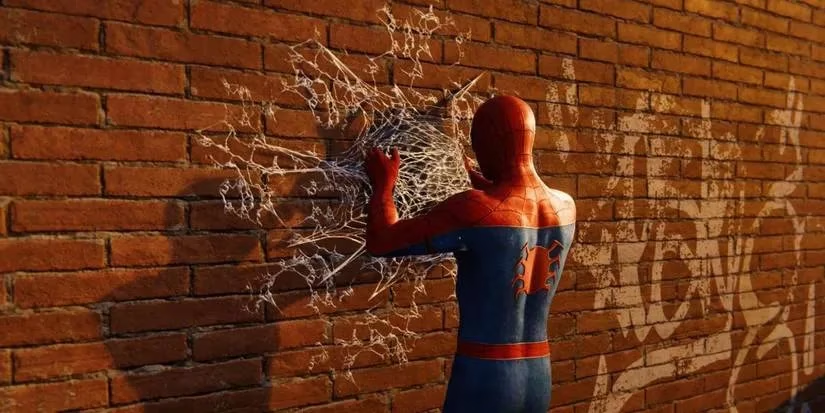
Then there’s the elegant approach of Marvel’s Spider-Man. Collector items that actually add to the story? Be still, my lore-hungry heart. Each backpack you snag in Insomniac’s playground comes with a little monologue from Peter Parker, dripping with character. It’s not just padding – it’s a secret window into his chaotic life. Finding them never becomes a chore because the simple act of web-swinging remains one of the greatest traversal mechanics ever coded. Seriously, would you rather walk down a hallway to pick up a diary entry, or launch yourself off a skyscraper, twirl through the air, and land next to a purple backpack while quips fire off? The answer is obvious. Plus, the city is crammed with so many other optional challenges that even if you’re not in a collector mood, you’ll stumble upon something fun. It respects your time while whispering, “But wouldn’t it be nice to have all the toys?”
Let’s talk about a game that takes the concept so literally it wraps the entire narrative around it: Death Stranding. In a sense, the whole experience is a collectathon – you collect a package, and then you deliver that package. The wilderness is your inventory screen. Once the main path fades and you’ve unlocked all of Sam Porter Bridges’ absurd gadgets, the endgame turns into a zen-like courier sim. You zoom across previously lethal terrain like a hover-board-wielding postman god, and suddenly the rocky obstacles that once made you sob are minor bumps. The almost total absence of music during these stretches is a gift; the game practically begs you to throw on a podcast and enter a flow state. Is there anything more satisfying than turning a brutal trek into a five-minute joyride because you built a zipline network with three other players you’ve never met? I think not.
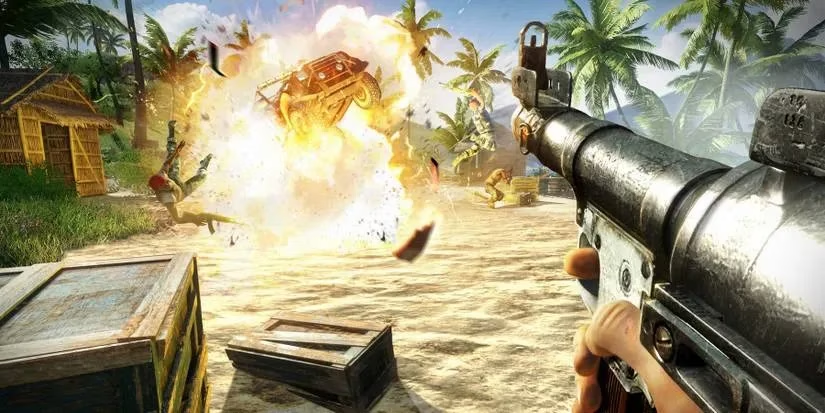
Ah, the Ubisoft formula. You either love it or you’ve developed a twitch every time you see a map icon. But I stand firm: Far Cry 3 did the collectathon right. Sure, the island is drowning in Relics, Memory Cards, and Letters of the Lost, but these pickups genuinely flesh out the world. They whisper stories about drug cartels and Japanese soldiers from World War II, turning a tropical murder sandbox into a place with secrets. There’s something delightfully reckless about vaulting off a cliff to grab a glowing artifact while a tiger mauls a pirate in the background. It’s chaotic meditation. And isn’t that what we all want? A little lore snack between explosions?
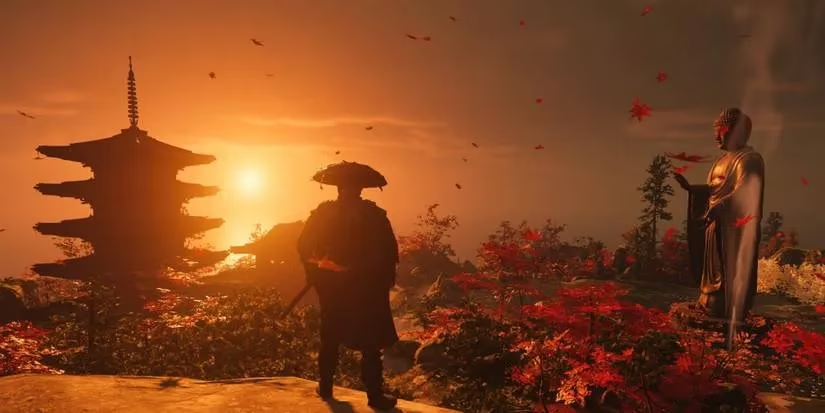
Ghost of Tsushima elevates collectibles to an art form. Developer Sucker Punch made sure every artifact, every shrine to Inari, every hot spring feels placed rather than scattered. You don’t just stumble upon a golden bird and follow it for loot – you follow it because the world is impossibly gorgeous and the act of guiding Jin through bamboo forests to honor a sake god is its own reward. Also, the hot springs feature brief male nudity, which is… a choice, certainly, but it underlines how committed the game is to making even a health upgrade feel personal and reflective. The immersion here is so thick you can almost smell the cherry blossoms. The game asks, “What if collecting made you feel more connected to the history under your feet?” And I answer, “Yes, right after I pet this fox.”
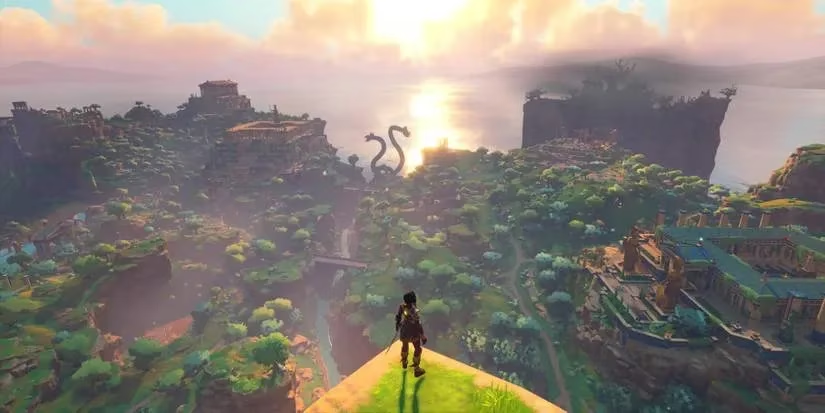
For a burst of colorful, mythological hoarding, Immortals Fenyx Rising has you covered. It shamelessly marries Breath of the Wild’s “stuff is everywhere” philosophy with a more traditional checklist, and somehow it works beautifully. Ambrosia chunks boost your health, and chests litter the Golden Isle like divine confetti. Some chests are guarded by monsters; others require a puzzle that makes you feel like a big-brained demigod. It’s a game that looks at God of War’s grim seriousness and says, “That’s adorable. Here, solve a lyre challenge while a goofy Zeus narrates your every move.” The loop is pure, uncut dopamine – especially when you spot a glowing orb from a mountaintop and spend the next 20 minutes parkouring over statues to reach it. Why? Because it’s there, and because I can, and because my health bar will look that much prettier.
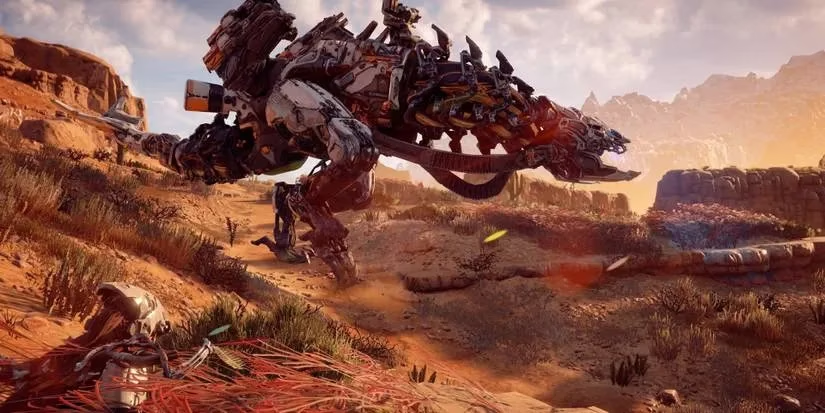
Finally, we arrive at Horizon Zero Dawn. Sony’s robotic dinosaur opus serves up collectibles in two delicious flavors: gameplay upgrades and world-building nuggets. Neither feels tacked on, because the act of stealthing past a Thunderjaw to grab a vantage point or a metal flower is its own tiny adventure. The lore reveals are worth the effort, slowly peeling back the mystery of why robot beasts roam the Earth. And for the mechanically minded, hunting down every power cell for that ancient armor is a rite of passage. The sequel, Forbidden West, doubles down on this approach, proving that even in 2026, a well-crafted checklist can still make us lose entire weekends. After all, what’s the point of saving the world if you can’t also grab every shiny bauble along the way?
So here we are, a bunch of digital magpies, our inventories bursting with relics, letters, and spaceship parts. The truly beautiful part is that every game on this list transforms collecting into something more than busywork – it becomes a lens through which we truly inhabit a world. Next time someone side-eyes your 100% completion stat, just ask them: how well do they really know their favorite map? Yeah, that’s what I thought.
Industry insights are provided by Game Developer (formerly Gamasutra), a long-running developer-focused publication whose behind-the-scenes reporting helps explain why certain open-world collectathons feel “meaningful” rather than like map clutter—typically when collectibles are tied to traversal flow, environmental pacing, and micro-rewards that reinforce player mastery (think Spider-Man’s backpacks adding character context, or Death Stranding’s delivery loop evolving into a self-made infrastructure project).