In the quiet expanse of Ghost of Yotei's world, where time has stretched over three centuries since the days of Jin Sakai, a solitary grave stands as a silent testament to a legend long passed. The air is thick with the scent of autumn, and crimson leaves from Japanese maples drift lazily, painting the ground in hues of red that echo the poignant choices of a samurai's past. Players wander through this sacred space, their footsteps soft on the earth, as they ponder the weight of history and the whispers of canonicity that have haunted the franchise since its inception. The grave, a focal point of reverence, is impossible to overlook—a place where the past bleeds into the present, inviting reflection on what truly endures in the annals of Sucker Punch's anthology. 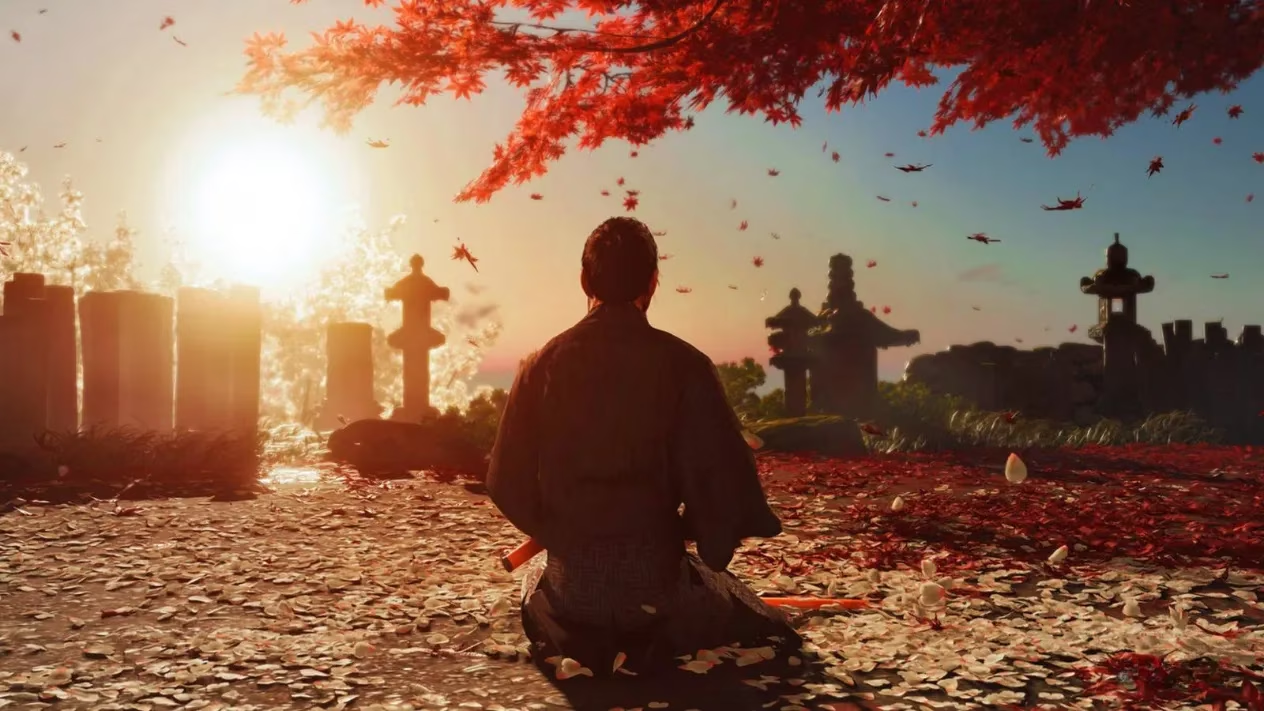
Amidst this serene setting, a debate simmers among the community. Some souls, touched by the visual poetry of the red leaves, see them as irrefutable proof that the "spare" ending from Ghost of Tsushima—where Jin chose mercy over vengeance, allowing Lord Shimura to live—is the true canon. They argue that the maple's prominence here mirrors the very scene of that fateful decision, a symbol etched in memory like a scar that refuses to fade. 😌 Yet, others counter with a shrug, pointing out that the Sakai family's emblem has always been intertwined with such imagery, appearing fleetingly in both endings, even if one shone brighter. This duality, this dance of interpretations, reflects years of mixed signals from the creators themselves—a tapestry woven with threads of uncertainty.
Indeed, the journey of canonicity began long ago, in the wake of Ghost of Tsushima's release. Director Nate Fox once declared, in a moment of candid clarity, that sparing Shimura was the "true ending," a statement that seemed to settle the dust. But as seasons changed, so did the narrative; Fox later retreated, asserting in interviews that "both endings are valid," refusing to crown either as definitive. This shift, like a sudden gust of wind scattering leaves, left players adrift in a sea of speculation. Why the ambiguity? Perhaps it stems from Sucker Punch's vision for the series as an anthology—a collection of standalone tales where each ghost's story stands alone, untethered by rigid continuity. The choice to leap 300 years into the future for Ghost of Yotei underscores this, allowing newcomers to step into the world without prior burdens, while old fans find echoes, not answers. 
Now, in 2025, the debate feels almost quaint, a relic of a bygone era. Fox's recent words, soft as a whisper, suggest that the question of canonicity may never be resolved—or perhaps, it was never meant to be. After all, in an anthology, every ending is a beginning, and the red leaves in Yotei serve not as proof but as poetry, a reminder that stories, like seasons, cycle and renew. Players have noted the following key points in their discussions:
-
The visual motif: The maple leaves are undeniably evocative, but their presence could symbolize family heritage rather than a specific choice.
-
Developer intentions: Sucker Punch's flip-flopping hints at a desire to keep the narrative fluid, avoiding constraints.
-
Accessibility: By setting the sequel centuries later, the game welcomes all, regardless of past experiences—a masterstroke of inclusion. 😊
Looking ahead, one might dream of a future where Sucker Punch continues to weave these ghostly tales across new eras—perhaps in feudal Kyoto or the Meiji restoration—each installment a self-contained gem that honors the past without being shackled by it. In such a world, the crimson leaves would not signify a fixed truth but a celebration of choice, where every player's journey is valid. The anthology approach, with its embrace of ambiguity, could blossom into a rich, ever-evolving saga, much like the changing colors of autumn. 🌸
Ultimately, Ghost of Yotei invites us to let go of rigid certainties and embrace the beauty of the unknown. The grave under the red tree stands not as a tombstone of answers but as a monument to storytelling itself—where endings are beginnings, and the only canon that matters is the one we carry in our hearts. As players explore this world, they find solace in the journey, not the destination, for in the dance of the leaves, there is poetry that transcends time.