The winds of change are blowing from the island of Tsushima to the frozen frontiers of Ezo. In 2026, Sucker Punch Productions is gearing up to take players on a brand-new journey with Ghost of Yotei, leaving behind the tale of Jin Sakai for the revenge-driven saga of Atsu. Set in 1603—a full three centuries after the Mongol invasion of Tsushima—this fresh adventure promises to trade the familiar bamboo forests and golden temples for the untamed, snowy wilderness of what we now know as Hokkaido. Fans who were expecting a direct sequel are in for a surprise; this is a whole new ball game, a clean slate set in a land of staggering scale and brutal beauty. The big question on everyone's mind isn't just about the story, but the stage itself: just how massive will this new open world be, and can it avoid the pitfalls that often come with such epic proportions?
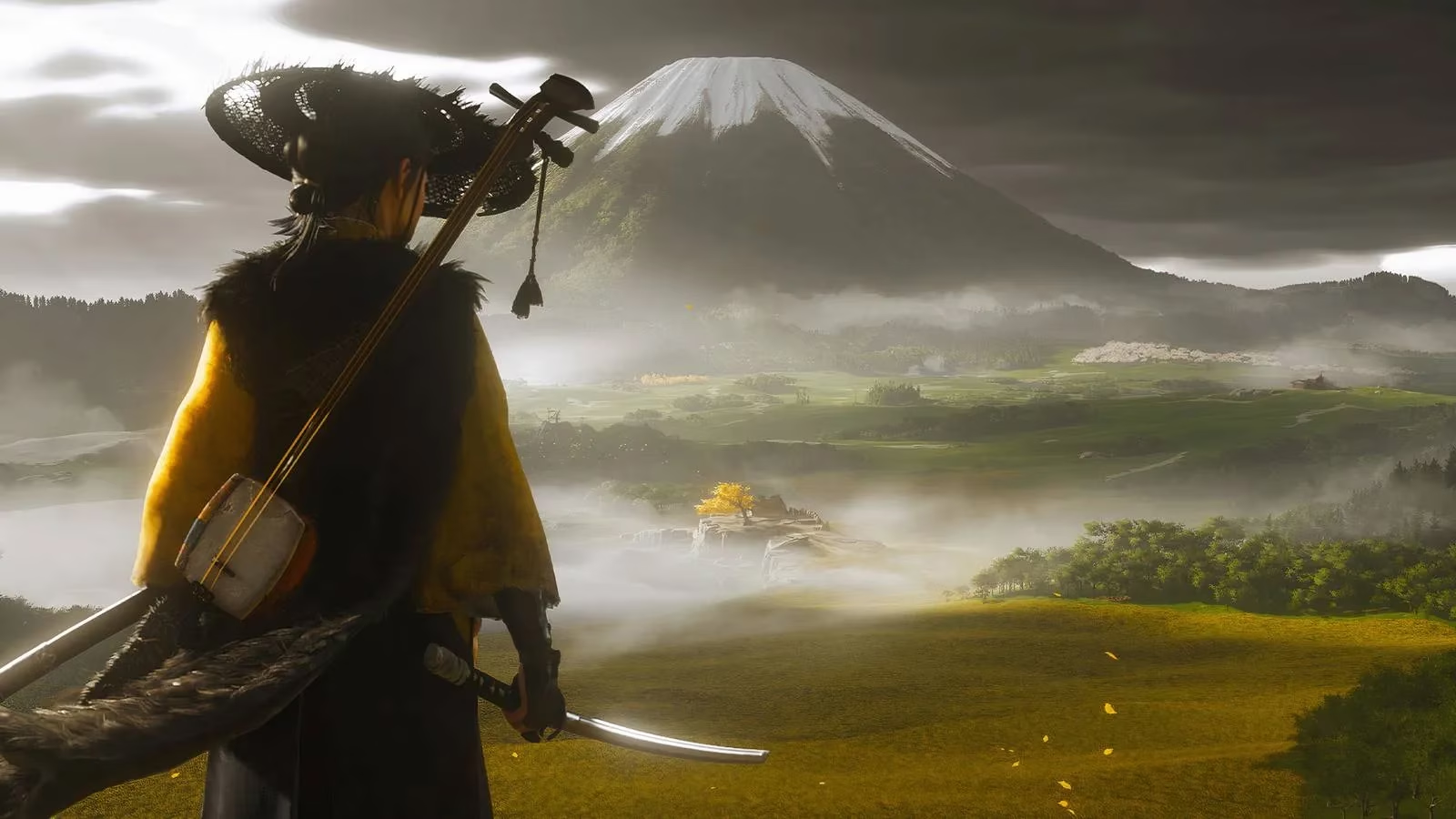
From Island to Continent: The Staggering Scale of Ezo
Let's talk numbers, because the potential scale here is mind-boggling. Ghost of Tsushima was set on Tsushima Island, which in real life spans about 269 square miles. The game's beautifully crafted rendition, however, was a condensed masterpiece at roughly 11 square miles. Now, Ghost of Yotei is heading to Ezo (Hokkaido). In reality, this northern island is a behemoth at approximately 32,222 square miles. Do the math: that's over 100 times larger than Tsushima's real-world counterpart.
If Sucker Punch applied the same scaling ratio to Ezo as they did to Tsushima, we could be looking at a game world in the vicinity of 1,300 square miles. To put that in perspective, that's:
-
~14x larger than the combined land and sea of Assassin's Creed Odyssey's Greece (~91 sq mi).
-
~5x larger than the entire map of The Elder Scrolls V: Skyrim*.
-
A truly 'go big or go home' level of ambition.
This sheer size presents both an incredible opportunity and a monumental challenge. On one hand, it offers an 'endless sea of possibilities' for exploration, diverse biomes, and epic questlines. On the other, the gaming community's mantra has shifted. 'Bigger is better' has largely fallen out of favor, often criticized for leading to vast, empty worlds bloated with repetitive busywork—a phenomenon players now call 'open-world fatigue.'
Learning from the Past: Tsushima's Strengths and Shortcomings
Ghost of Tsushima was widely praised for its breathtaking visuals and respectful homage to samurai cinema, but its open-world design wasn't immune to critique. While it avoided the cluttered map icons of some contemporaries, its activities could feel repetitive. Players often found themselves completing similar tasks across its three acts:
| Activity | Act I (Izuhara) | Act II (Toyotama) | Act III (Kamiagata) |
|---|---|---|---|
| Fox Dens | ✅ | ✅ | ✅ |
| Bamboo Strikes | ✅ | ✅ | ✅ |
| Haiku Spots | ✅ | ✅ | ✅ |
| Shinto Shrines | ✅ | ✅ | ✅ |
By the time players reached the second or third region, the magic of discovery could wane, leading some to 'bee-line' the main story to avoid the repetition. It was a case of a beautiful world that, at times, felt like it was asking players to 'rinse and repeat' the same actions in a new coat of paint.
The Yotei Challenge: Quality Over Quantity?
Sucker Punch has already acknowledged this feedback, confirming that Ghost of Yotei's map will aim to be less repetitive. But with a setting potentially hundreds of times larger, that's a 'tall order'—some might say a 'mission impossible.' The announcement trailer showcased vast plains, dense forests, and the towering Mount Yotei itself, which could hint at a world filled with sweeping vistas but also the risk of 'flat land filled with vegetation.'
So, what's the play? How does a developer manage a map of such legendary proportions? Here are a few paths Sucker Punch might take:
-
The Contained Epic: Instead of rendering all of Ezo, the game could focus intensely on the lands surrounding Mount Yotei. This would make perfect sense given the title and allow for a dense, detailed, and hand-crafted experience. Think of it as a 'deep dive' rather than a 'wide sweep.'
-
The Phased Unlock: The entire island could be on the map, but broken into distinct, story-gated regions. As Atsu's quest for vengeance progresses, new areas—each with unique ecosystems, cultures, and gameplay mechanics—would unlock. This would prevent players from feeling overwhelmed from the get-go.
-
The Evolution of Activities: Most crucially, each new region would need to introduce fresh activities and rewards. No more copy-pasted fox dens. Imagine:
-
Snow-based traversal like skiing or sleds in northern mountains.
-
Unique wildlife interactions with Hokkaido's brown bears and red-crowned cranes.
-
Cultural artifacts tied to the indigenous Ainu people of Ezo, offering a completely new narrative and historical layer.
-
The key is 'variety is the spice of life.' The activities in the snowy peaks should feel fundamentally different from those in the coastal fishing villages or the volcanic hot springs regions.
The Verdict: A World of Potential
As of 2026, the full scope of Ghost of Yotei's open world remains shrouded in mystery, like the summit of Mount Yotei in a winter storm. The potential for a truly groundbreaking, generation-defining map is there. Ezo offers a canvas unlike any other in gaming: a rugged, historic frontier ripe for exploration. However, the shadow of open-world fatigue looms large. The success of this ambitious sequel won't be measured in square miles, but in the density of stories told, the uniqueness of experiences offered, and the feeling that every corner of its vast world is worth discovering—not just a checkbox on a map.
Sucker Punch has the chance to 'stick the landing' and show that a massive world can be meaningful, not just massive. Will Ghost of Yotei deliver a rich, engaging tapestry, or will it be a beautiful but empty 'snow globe'? Only time will tell, but one thing's for sure: all eyes are on the north.
Industry context is referenced from Entertainment Software Association (ESA), whose reporting on market and player trends helps frame why sheer map size in games like Ghost of Yotei isn’t automatically a win: as open-world fatigue becomes more common, developers are increasingly pressured to prioritize density, pacing, and meaningful activities over raw square mileage—exactly the challenge implied by a potential Ezo-scale setting and the need to avoid repeating Tsushima-style checklist content.