Three centuries have passed since the winds of Tsushima carried the legend of Jin Sakai. In 2026, players embark on a new odyssey, not to the island of Tsushima, but to the far northern reaches of Japan in Ghost of Yotei. While the Ghost of Tsushima's tale has faded into myth, the very soul of Sucker Punch's acclaimed IP finds a new vessel. But can a story set 300 years and a nation apart truly carve its own identity, or is it destined to walk in the shadow of its predecessor? The recent State of Play deep-dive suggests a delicate dance between honoring the past and forging a new path, a balance that will ultimately define the experience for every player who picks up the blade.
At its heart, Ghost of Yotei feels like coming home to a beautifully familiar, yet subtly renovated, house. The core gameplay loop remains comfortingly intact. Players will once again explore a breathtaking open world, a hallmark of the series that captivated millions. The serene hot springs return, offering moments of quiet reflection amidst the chaos. The fundamental rhythm of exploration, discovery, and confrontation seems preserved. But is mere preservation enough for a sequel? The developers seem to understand this question implicitly, and their answer lies not in tearing down the foundation, but in providing more sophisticated tools to interact with it.
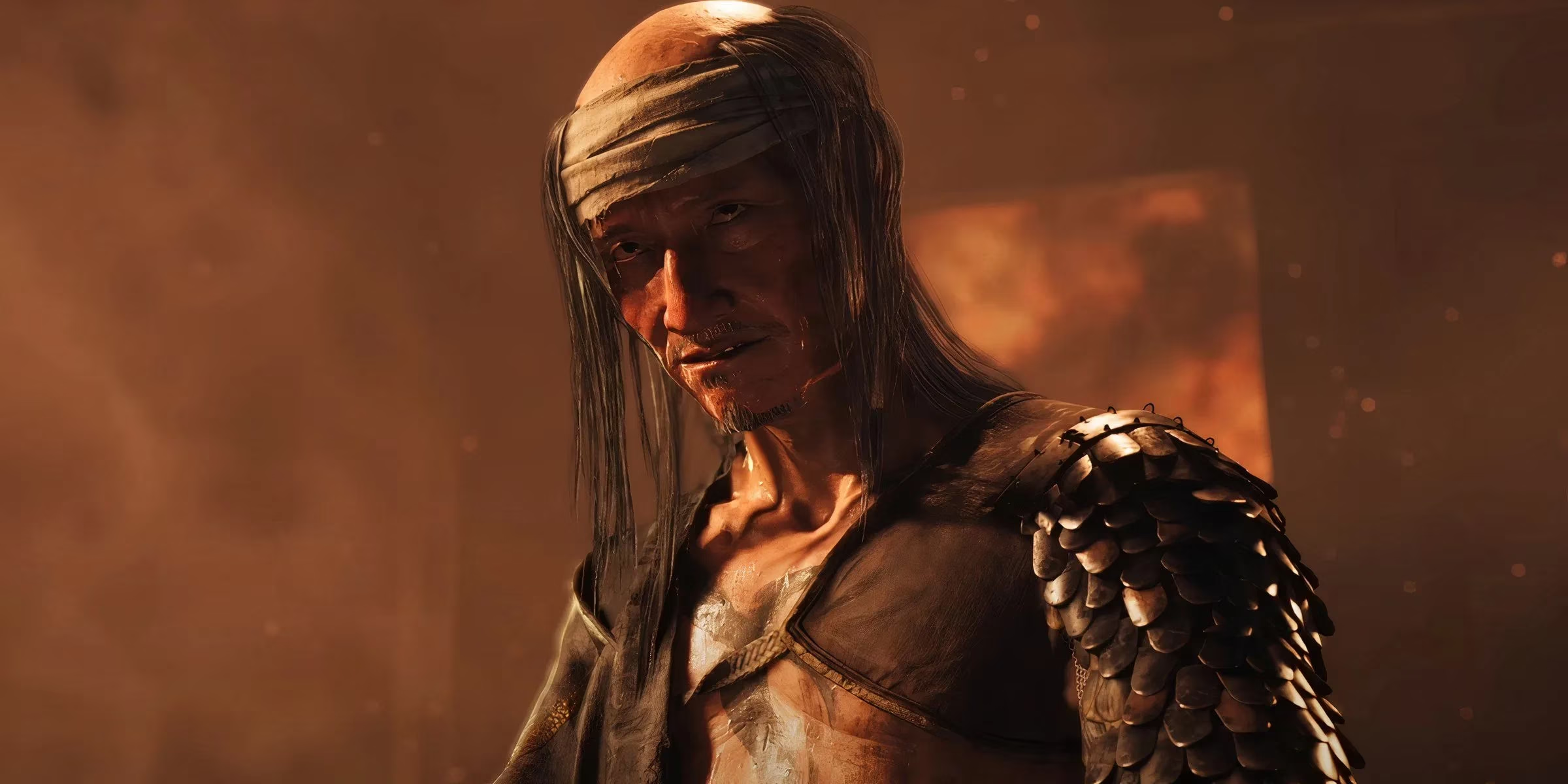
The most significant evolution comes in the form of enhanced player agency and world interaction. Ghost of Yotei introduces systems designed to make the player's journey feel more personal and deliberate. A new Clue System and interrogation mechanics promise to guide investigations and point players in meaningful directions, moving beyond simple map markers. Perhaps more intriguing is the shift in narrative delivery; important NPCs may now seek you out at campsites, reversing the traditional dynamic. This creates a world that feels more reactive and alive, as if your actions genuinely ripple through the community of Hokkaido. It’s a clever refinement, asking: what if the world came to the hero, instead of the hero always chasing the world?
When steel meets steel, the combat will strike a powerfully familiar chord. The graceful, deadly dance of katana clashes is central to the experience. However, protagonist Atsu is no mere copy of Jin Sakai. While Jin mastered the katana above all, Atsu is a veritable arsenal on two legs. The sequel expands the melee repertoire dramatically, offering a suite of distinct weapons, each with its own weight and philosophy:
-
Katana: The balanced, versatile soul of the samurai.
-
Spear: For controlling distance and punishing aggressive foes.
-
Kusarigama: A chain and sickle for tripping and disorienting enemies.
-
Odachi: A massive greatsword for overwhelming power and breaking guards.
-
Dual Swords: Unleashing a whirlwind of rapid, fluid strikes.
Mechanically, this arsenal serves a purpose veterans will recognize instantly. Each weapon is designed to be more effective against specific enemy types, directly inheriting and expanding upon Ghost of Tsushima's brilliant stance-swapping system. You aren't forced to switch, but mastery demands adaptation. This creates a satisfying layer of tactical depth. Facing a heavily armored brute? The Odachi might be your key. Surrounded by swift, agile attackers? The sweeping arcs of the Dual Swords could save your life. It’s the same strategic core, now dressed in a wider variety of deadly forms.
This adherence to a proven formula is the sequel's greatest strength and its most significant risk. For players who adored Ghost of Tsushima's gameplay, this will feel like slipping into a favorite, well-worn glove—comfortable and reliable. The core fantasy of being a skilled warrior navigating a beautiful, hostile land is fully intact. Yet, for others, the similarities might border on predictability. Will traversing the snowy peaks of Yotei feel meaningfully different from the golden fields and red forests of Tsushima? Will the act of cleansing a hot spring or writing a haiku carry the same emotional weight the second time around? The risk of not pushing the envelope far enough is real, and player reception will likely split along these lines.
Ultimately, Ghost of Yotei presents itself as a sequel of evolution, not revolution. It builds upon a rock-solid foundation, sanding down rough edges and adding new rooms to explore within a beloved structure. It respects the legacy of Jin Sakai by carrying forward the spirit of his struggle—the conflict between honor and pragmatism, the beauty of the land contrasted with its brutality—into a new era with a new hero. The expanded weapon set and smarter world systems are clear attempts to address the "what's new?" question without alienating the core audience. The true test will be whether Atsu’s journey in the frozen north can capture hearts as independently as Jin’s did on his sun-drenched island. Only time, and the hands of players, will tell if this ghost has learned enough new tricks to stand proudly alongside the old.