When I first saw the announcement for Rise of the Ronin back in 2022, my mind instantly jumped to Ghost of Tsushima. Another samurai game set in Japan? It felt like a direct echo. Yet here I am, halfway through 2026, having poured hundreds of hours into both, and I can confidently say that expecting a clone was the biggest mistake I could have made. These two titles orbit completely different stars, and once you sink into their worlds, the gap between them grows into a fascinating study of what makes a samurai adventure truly tick.
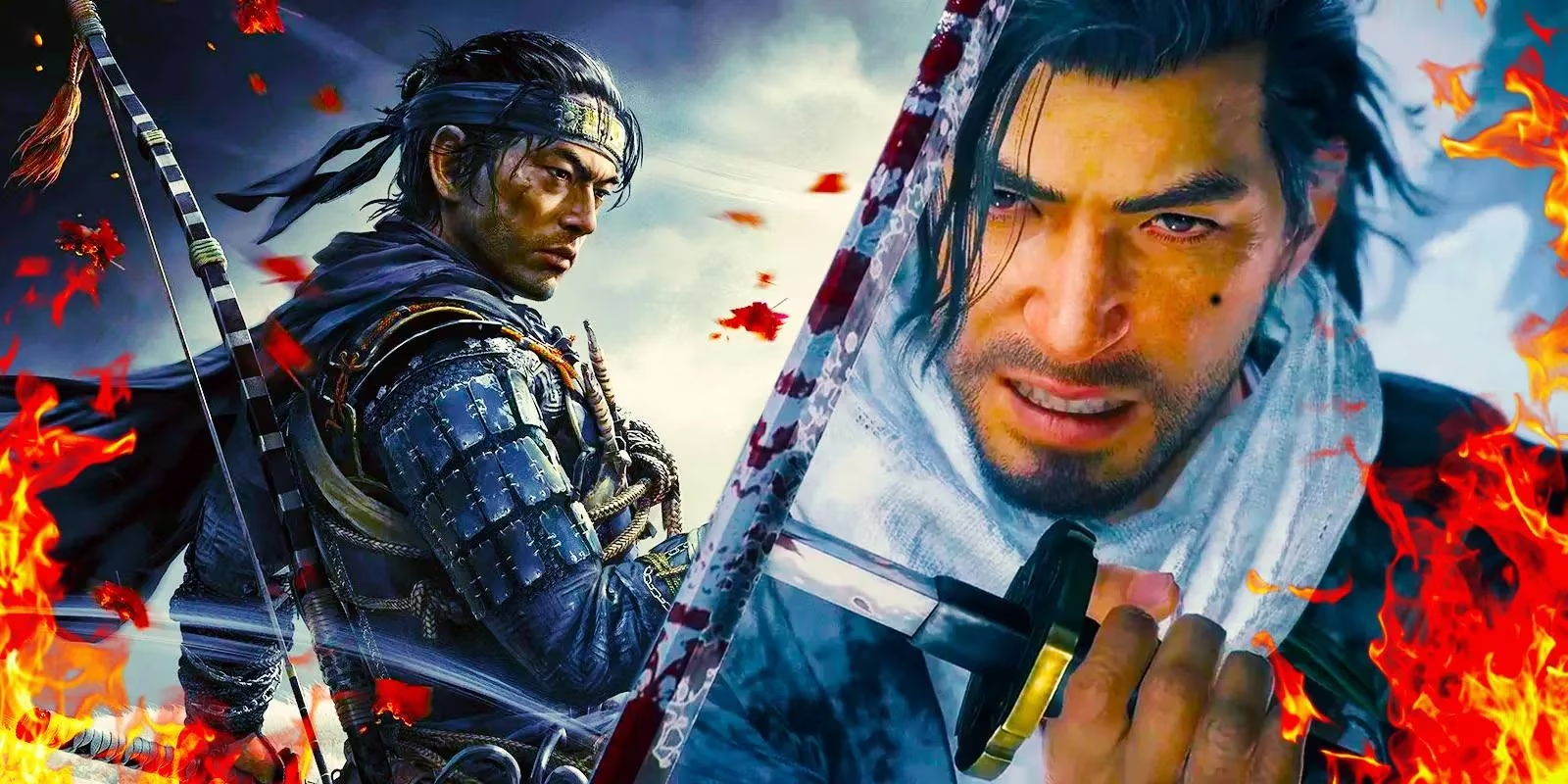
I noticed the first major rift the moment I opened my inventory. In Ghost of Tsushima, every armor set feels handcrafted for a specific fantasy — the unyielding samurai, the ghostly assassin, the master archer. There are only 11 core sets (plus those added in the Iki Island expansion), but each one transforms your approach. You upgrade them in three deliberate steps, and all those masks and helmets are purely cosmetic, so you never have to sacrifice style for stats. Rise of the Ronin, on the other hand, throws more than 50 armor sets at you. Headgear, boots, and chest pieces can be mixed freely, giving thousands of aesthetic combinations. The catch? Most gear offers passive bonuses like a tiny damage boost or a sliver of extra health. I miss the bold, style-defining abilities of Jin Sakai's wardrobe. Here, I often feel like I'm chasing numbers rather than embodying a role.
Then there’s the story itself. Ghost of Tsushima follows one man’s painful journey: Jin is forced to betray his uncle’s rigid code to save his people, and the only real choice you make comes in the final, tear-soaked moments. It’s a straight, powerful line. Rise of the Ronin completely shatters that mold. Set in the late 1800s, right as the Tokugawa shogunate crumbles, you dance between factions, nurture bonds with specific characters, and each decision can lock you out of alliances or open surprising friendships. I played through twice, once backing the pro-shogunate forces and once supporting the anti-shogunate rebels, and the two campaigns felt like separate novels. That dynamic makes RotR endlessly replayable, but I’d be lying if I said I didn’t miss having a protagonist with a soul as defined as Jin’s. My Veiled Edge twin rarely speaks in cutscenes; I pick dialogue from text options, Skyrim-style, and even with a full voice pitch editor, the character remains a blank slate. Jin’s voice, acted with such raw emotion by Daisuke Tsuji, still haunts me years later.
The time gap isn’t just a detail — it’s the engine behind every other difference. Ghost of Tsushima plants you in 1274, where one island unites against Mongol invaders. Rise of the Ronin drops you 600 years later, into an era of industrial smoke, political intrigue, and... guns. I still remember the first time I equipped a revolver in RotR. It felt like cheating until I realized it’s balanced: slow, loud, and far less elegant than the bow I’d come to love on Tsushima. The weapon diversity is staggering: katana, odachi, paired swords, spear, polearm, sabre, bayonet, greatsword, oxtail blade, and even fists. Each has 25 levels of progression that unlock new stances. In contrast, Ghost of Tsushima gives you only a katana and a tanto (the latter just for stealth), but it makes every single strike a brushstroke.
Combat is where my muscle memory screams the loudest. Ghost of Tsushima feels like a deadly dance; enemies telegraph clearly, and a single perfect parry often ends them. Standoffs let you carve through a squad in seconds. Rise of the Ronin shows no such mercy. Its Counterspark system demands precise, rapid-fire parries to drain an enemy’s Ki before you can even think about a critical hit. I died more times in the first five hours of RotR than in an entire replay of GoT on lethal difficulty. That steep climb is rewarding, but don’t walk in expecting Jin’s fluid elegance — you’ll get carved up.
The worlds themselves tell the same story. Tsushima’s three interconnected regions weave a tapestry of golden forests, haunting bamboo groves, and wind-swept coasts. You can ride from one end of the island to the other without a single loading screen, and every detour uncovers a fox den or a hidden hot spring. Rise of the Ronin splits its map into three separate urban hubs — Yokohama, Edo, and Kyoto — and while the crowded streets and towering roofs are breathtaking, I constantly found myself missing that seamless, contemplative nature. To be fair, RotR’s Glider adds a joyful verticality: you can leap from a pagoda, soar across a district, and drop-assassinate a target below. It’s pure fun, but it replaces the patient, meditative travel of Ghost of Tsushima with a gadget-driven rush.
Multiplayer is another chasm. Ghost of Tsushima’s Legends mode is a separate, mythological co-op experience; I can’t bring my Jin into it. Rise of the Ronin lets you tackle campaign missions with up to three friends, all using their own customized characters. When a mission is too tough, I can summon an online ally or switch to a bonded NPC and experience their weapon moveset firsthand. This seamless blend of solo and co-op kept my buddies and me coming back long after the credits rolled.
At the end of the day, these two games aren’t rivals — they’re parallel journeys through wildly different Japans. Ghost of Tsushima remains the ultimate cinematic samurai power fantasy, while Rise of the Ronin unfolds as a complex, choice-driven odyssey of political upheaval. I adore them both for entirely opposite reasons. If you’re still comparing them in 2026, I promise you: let go of the expectation, and you’ll discover two masterpieces that couldn’t be more distinct.