It was July 2020. The world was on pause, locked indoors, and the future felt like a fragile, uncertain thing. For one expectant father, the cozy digital routines of Animal Crossing: New Horizons and the epic nostalgia of Final Fantasy 7 Remake were his daily escapes. Then, a friend's offhand comment introduced a name he'd never heard: Ghost of Tsushima. Intrigued, he dove into reviews and found himself asking a simple, urgent question: Why wasn't I playing this right now? That single question led to the purchase of a game that would become far more than entertainment—it became a sanctuary, a place to breathe during a year defined by suffocating uncertainty.
What made this open world so different? By 2020, the gaming landscape was saturated with vast maps filled with icons, checklists, and repetitive activities. Games like Assassin's Creed Odyssey offered hundreds of hours of content, which was perfect for someone with ample free time. But Ghost of Tsushima approached its world differently. Sure, it had familiar elements—map markers, side activities—but its magic wasn't in the quantity of content. What if a game's world wasn't a checklist, but an invitation? That was the core of the Tsushima experience. It wasn't about forcing you to complete tasks; it was about gently guiding you to find peace within its borders.
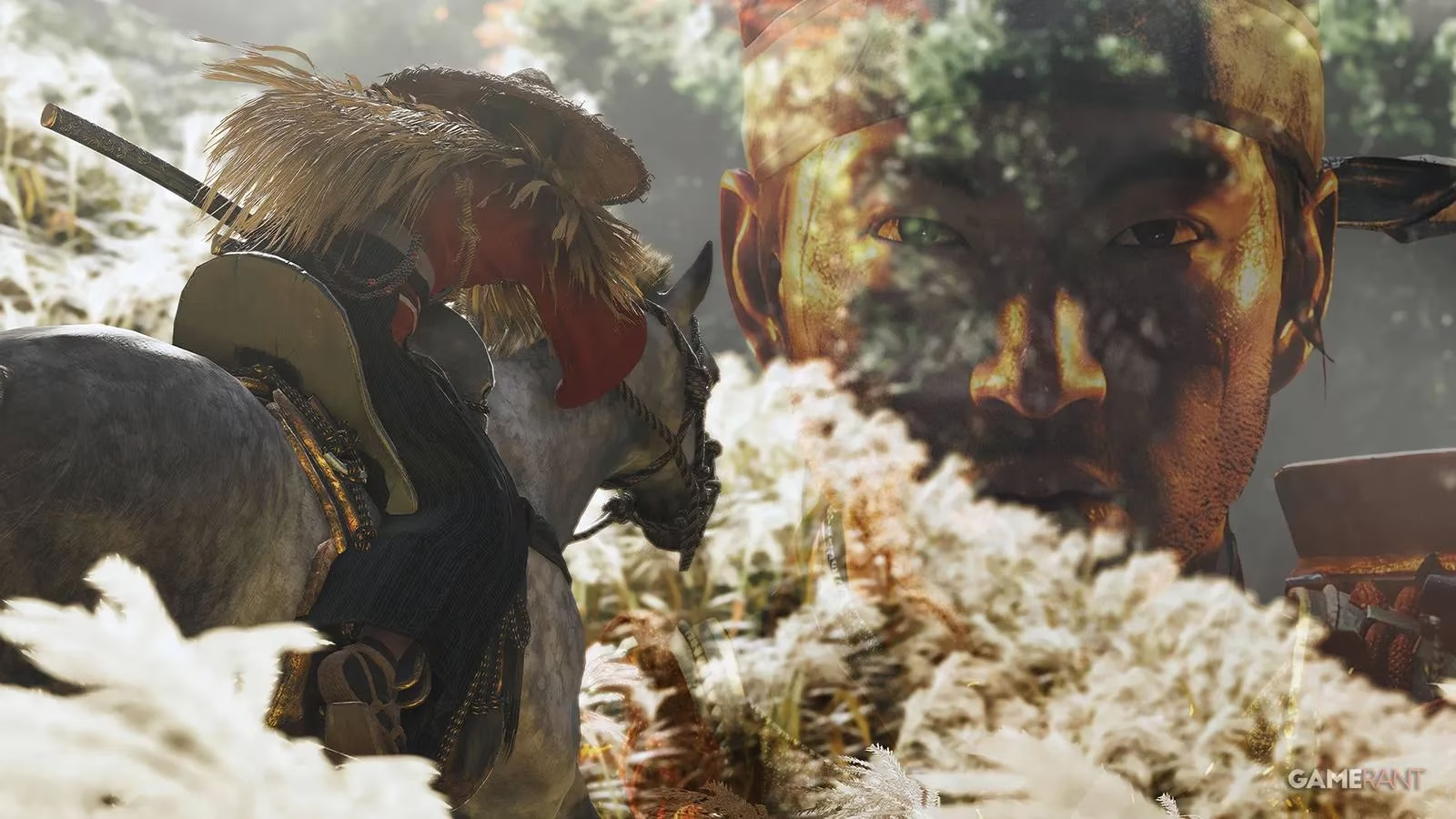
The key to this immersion was a revolutionary, beautifully simple mechanic: The Guiding Wind. Forget cluttered minimaps and intrusive compasses. Tsushima Island spoke through the environment itself. A gentle breeze, visualized by swirling leaves and grass, would point the way. Setting a custom waypoint didn't create a line on a screen; it summoned the wind to whisper the direction. This wasn't just a clever UI trick—it was a philosophy. 🍃 It encouraged you to invest in the journey, not just the destination. The sound of the wind rustling through bamboo forests or across golden fields wasn't just ambiance; it was a balm, creating an overwhelming sense of calm as you explored. In a year of constant digital noise and alarming news alerts, this quiet, natural guidance system felt profoundly healing.
This design philosophy extended to the entire Heads-Up Display, or rather, the lack of one. Ghost of Tsushima employed a stunningly minimalistic HUD that would fade away when not needed, ensuring nothing came between the player and the breathtaking vistas of feudal Japan.
| Traditional Open-World Guide | Ghost of Tsushima's Guide | Emotional Impact |
|---|---|---|
| Mini-map/Compass Clutter | The Guiding Wind & Animal Guides | Encourages observation & calm |
| Quest Logs & Objective Text | Environmental Storytelling & Visual Cues | Fosters immersion & discovery |
| Ubiquitous UI Elements | Dynamic, fading HUD | Prioritizes beauty & serenity |
Exploration in Tsushima felt less like a gameplay loop and more like genuine discovery. You could ignore the main quest for hours, simply letting your curiosity lead. Would you follow a fox to a hidden shrine? 🦊 Would you compose a haiku at a scenic overlook? Would you stand silently in a field of vibrant pampas grass as the sun set? Every direction felt meaningful. While the real world asked us to stop entirely, Ghost of Tsushima simply asked us to slow down. It transformed wandering from a time-filling activity into a purposeful, meditative practice.
And in that space, peace was found. The game’s world became a silent rebuttal to the cacophony of anxiety, confusion, and doubt echoing across social media and news cycles. It didn't offer answers to the big, scary questions of 2020. Instead, it offered something arguably more vital: a place to exist, to breathe, and to remember what tranquility felt like. For a player feeling trapped, both physically at home and mentally by global events, Tsushima Island was a temporary escape that restored a sense of agency and calm.
Five years later, as we look back, the legacy of Ghost of Tsushima isn't just about its acclaimed combat or story. For many who played it during that unprecedented time, its legacy is emotional. It proved that an open world could be more than a playground of activities—it could be a therapeutic landscape, a digital sanctuary built not on urgency, but on serenity. It asked a quiet question that resonated loudly: In a world demanding you to stop, what if you were instead gently guided to simply... be?